Human Trafficking Awareness and Prevention
CATA joins the fight against human trafficking. Learn to recognize the signs, understand the risks, and take action to report suspicious activity
Campaign Overview
In partnership with the Lansing Police Department and the U.S. Department of Homeland Security, CATA has launched a human trafficking awareness and prevention campaign.
In January 2020, CATA was awarded a $75,000 grant through the Federal Transit Administration’s Human Trafficking Awareness and Public Safety Initiative, along with additional support from the Michigan Department of Transportation. The Lansing Police Department also provided in-kind support.
According to the Polaris Project, Michigan ranks seventh in the United States for human trafficking cases, with Lansing among the top five cities in the state for hotline reports.
This campaign aims to raise awareness across the region and provide clear guidance on how to identify and help prevent human trafficking. With support from local and federal partners, CATA is implementing an awareness-driven, prevention-focused initiative across multiple platforms.
Learn more below about human trafficking and how you can help
Blue Campaign
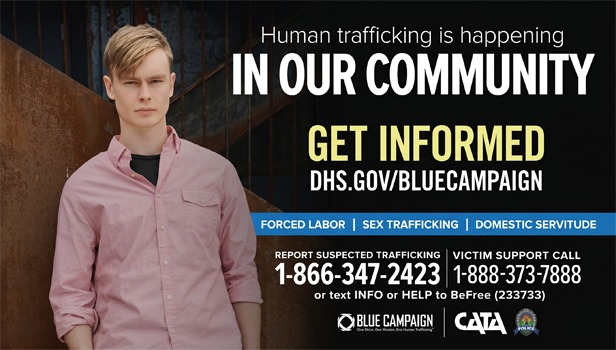
The U.S. Department of Homeland Security’s Blue Campaign is a national public awareness campaign. It educates the public, law enforcement and other partners on how to recognize the indicators of human trafficking and how to respond. Blue Campaign works with DHS to create training and materials that help increase detection of trafficking and identify victims.
Located within the Office of Partnership and Engagement, Blue Campaign works with the private sector, non-governmental organizations, law enforcement and state and local authorities. Its two core goals are prevention of human trafficking and protection of exploited persons.
“The Blue Campaign is proud to announce a new, joint partnership with the Lansing, MI Police Department and Capital Area Transportation Authority,” said Brandi Bynum, Program Manager for the DHS Blue Campaign. “Through this partnership, Blue Campaign resources, including posters, will be placed at transportation hubs throughout the City of Lansing to help local residents identify and recognize indicators of human trafficking and to help potential victims seek support. Partnerships like these enable us to help citizens recognize and report this terrible crime.”
See Say Campaign
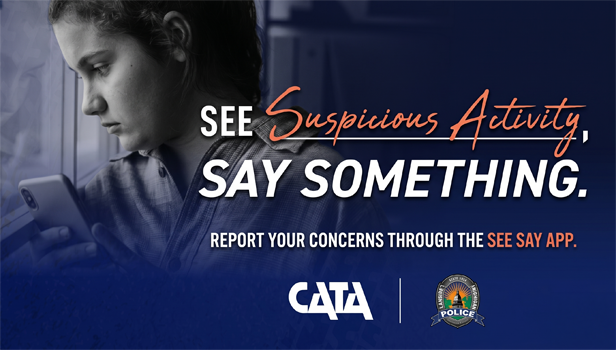
One of the components of CATA’s human trafficking awareness and prevention campaign was the debut of the See Say app, which invites members of the public to anonymously report safety concerns and suspicious activities, including suspected human trafficking in the Mid-Michigan region.
Over 30 North American transit agencies and major U.S. airports already use ELERTS’ system to let passengers and employees report safety and security concerns. Hundreds of reports of suspected human trafficking have already been submitted using See Say- the only crowd-sourced mobile-reporting solution cited in the U.S. Department of Transportation’s report “Combatting Human Trafficking in the Transportation Sector.”
The 3-year contract for the See Say app has since expired as of June 20, 2025. Customers are encouraged to contact law enforcement of the National Human Trafficking Hotline at 1-888-373-7888 if they see something suspicious. For all other concerns, contact CATA Customer Experience.
What is human trafficking?
- Human trafficking involves the use of force, fraud or coercion to obtain labor or commercial sex acts. Every year, millions of men, women and children are trafficked worldwide — including right here in the United States. It can happen in any community. Victims can be any age, race, gender or nationality. Traffickers may use any of the following methods to lure victims:
- Violence
- Manipulation
- False promises of well-paying jobs
- Romantic relationships
- Language barriers, fear of their traffickers and/or fear of law enforcement frequently keep victims from seeking help, making human trafficking a hidden crime.
How do I identify human trafficking?
- Does the person appear disconnected from family, friends, community organizations or houses of worship?
- Has a child stopped attending school?
- Has the person had a sudden or dramatic change in behavior?
- Is a juvenile engaged in commercial sex acts?
- Is the person disoriented or confused, or showing signs of mental or physical abuse?
- Does the person have bruises in various stages of healing?
- Is the person fearful, timid or submissive?
- Does the person show signs of having been denied food, water, sleep or medical care?
- Is the person often in the company of someone to whom he or she defers? Or someone who seems to be in control of the situation, e.g., where they go or who they talk to?
- Does the person appear to be coached on what to say?
- Is the person living in unsuitable conditions?
- Does the person lack personal possessions and appear not to have a stable living situation?
Does the person have freedom of movement? Can the person freely leave where they live? Are there unreasonable security measures?
Not all indicators listed above are present in every human trafficking situation, and the presence or absence of any of the indicators is not necessarily proof of human trafficking.
How do I report it?
- Get help from the National Human Trafficking Hotline by calling 1-888-373-7888 or texting HELP or INFO to 233733 (BEFREE).
- To report suspected human trafficking to federal law enforcement call 1-866-347-2423.